

TL;DR
Many "eco" laundry powders sold in Australia in 2026 fall short on at least one of four important criteria that actually matter: independent ingredient hazard ratings, plastic-free packaging, named manufacturing, and a third-party certification with a body behind it. This guide gives you a 60-second grading framework so you can rank any powder on the shelf without trusting the front-of-pack copy. The headline finding: roughly 87 to 88 percent of "recyclable" plastic detergent bottles end up in landfill anyway (around 12-13% of all plastics were recovered according to APCO 2022-23 data), "biodegradable" packaging is not the same as compostable, and the price gap between eco and conventional powder is roughly half what the supermarket aisle suggests once you do the per-wash math. If you want a specific pick at the end, read #1 or #2. This piece teaches you to grade for yourself.
What most buyers don't realise
A "recyclable" plastic detergent bottle has, statistically, a high chance of ending up in landfill in Australia in 2026. Around 12-13% of all plastics were recovered in Australia according to APCO 2022-23 data, and kerbside soft-plastic recycling effectively collapsed when REDcycle suspended in November 2022. The chasing-arrows symbol on the back of the pack is, charitably, optimistic. More accurately, it's the line the ACCC has been actively prosecuting since 2023 (ACCC greenwashing internet sweep). One AU civil penalty for unsubstantiated "ocean plastic" packaging claims hit $8.25 million.
This is the single most important thing to internalise before you grade a powder: the front of the pack is marketing, the back of the pack is evidence, and the gap between the two is wider than the category wants you to know.
What you'll know by the end
You'll be able to walk into Coles, Woolworths, Flora and Fauna, Biome, or any independent eco grocer, pick up a powder, and grade it on a four-axis framework (ingredients, packaging, manufacturing, certifications) in under a minute. You'll know how to read an EWG rating without trusting the brand's summary of it. You'll know which Australian certifications carry weight and which are marketing words. You'll be able to do the cost-per-wash math in your head and see why $10/kg supermarket detergent is often more expensive per wash than $18 concentrated eco powder. And you'll have a printable greenwashing red-flags table that strips "natural," "eco," and "plant-based" of any persuasive load.
The four-axis framework
Use these four axes, in this order, every time.
- Ingredients. What is the powder actually made of, and is each ingredient independently rated low-hazard?
- Packaging. Is it plastic-free, compostable, or paper, or is it plastic in eco dressing?
- Manufacturing. Where is it made, by whom, and what's the supply-chain footprint?
- Certifications. Are the eco claims backed by an independent third party, or are they marketing words?
A powder that passes three of four is a credible buy. Two of four is greenwashing risk. One of four is conventional detergent in a green wrapper.
Axis 1: Ingredients
What good looks like
Plant-based surfactants (typically coconut-derived). No SLS, no SLES. No phosphates. No optical brighteners. No synthetic fragrance. Enzyme blends rather than chlorine bleach for stain lift. Where ingredients are scored, every ingredient EWG-rated 1 to 3, with the bulk at 1 or 2.
What to avoid
| Ingredient | Why it's on the avoid list |
|---|---|
| SLS / SLES (sodium lauryl sulfate / sodium laureth sulfate) | Skin irritation in sensitive users; SLES can carry 1,4-dioxane contamination from manufacturing |
| Phosphates | Voluntarily phased out by major AU manufacturers by 2014 under ACCORD industry standard, but can appear in some imports; aquatic eutrophication |
| Optical brighteners | Synthetic dyes that stay on the fabric, transfer to skin, don't biodegrade |
| Synthetic fragrance / parfum | Undisclosed mixtures, common allergen and asthma trigger |
| Chlorine bleach | Harsh on fabric and skin; reacts with organic matter to form chlorinated byproducts |
| Quaternary ammonium compounds (quats) | Antimicrobial, but linked to respiratory irritation and resistance concerns |
How to read EWG ratings without getting played
The Environmental Working Group is a US non-profit that publishes a free database called the Guide to Healthy Cleaning (ewg.org/cleaners). It rates cleaning ingredients on a 1 to 10 hazard scale. It also issues an overall A to F product grade using a weight-of-evidence method.
Reading the scale:
- EWG 1 to 2: low concern. Safe for sensitive users. The tier you want every ingredient in.
- EWG 3 to 4: moderate concern. Often used in builder or surfactant components. One or two ingredients in this band is acceptable; a powder full of them is not.
- EWG 5 to 7: higher concern. Skin or respiratory irritation risk. Avoid for kids, eczema, or asthma households.
- EWG 8 to 10: known toxicity, endocrine-disruption, or carcinogenicity flags. Best avoided, especially for households with kids, pets, eczema, or sensitive skin.
To grade a product, search ewg.org/cleaners by brand name, or read the back of the pack and look up each ingredient individually. Brands that publish per-ingredient EWG ratings offer stronger transparency for customers making informed choices.
A note on EWG limitations: it's US-based, so AU-specific brands may not appear. Its methodology is conservative and weights novel data heavily, which some chemists argue overstates risk for well-studied surfactants. Treat it as one strong signal, not the only signal. Per-ingredient transparency, on a PDP, is still the cleanest tell that a brand is willing to be graded.
"Natural" is not a regulated term
Bicarb soda is natural. So is hydrochloric acid. The word doesn't protect you. If "natural" is the most specific word on the pack, the ingredient list will tell you far more than the front-of-pack wording.
Axis 2: Packaging
This is where packaging claims can be most confusing for customers.
The hierarchy, best to worst
- Home-compostable bag or paper. Breaks down in a domestic compost bin within months. Rare. The gold standard.
- Industrially compostable bag. Breaks down in commercial composting facilities. Better than landfill, conditional on a commercial facility being accessible. Some councils accept it; many don't. Brand take-back programs are the practical workaround.
- Paper or cardboard box. Recyclable kerbside, biodegradable in landfill. Solid choice if uncoated and plastic-liner-free.
- Refill scheme with returnable container. Glass or aluminium that comes back for cleaning and refilling. Good in theory; depends on participation rates.
- "Recyclable" rigid plastic. PET or HDPE bottles in the yellow bin. Higher recovery than soft plastic, still loss-heavy.
- "Recyclable" soft plastic. The lowest tier. Kerbside soft-plastic recycling collapsed in AU in November 2022 with the REDcycle suspension. Overall plastic recovery in AU sits at around 12-13% of all plastics (APCO 2022-23), and soft plastics fare worse than rigid.
- Multi-layer plastic / plastic-foil composite. Effectively non-recyclable in AU. Lands in general waste.
"Biodegradable" is not "compostable"
These two words are used interchangeably in marketing. They're not the same thing.
- Biodegradable has no required timeframe. "Biodegradable" plastic in landfill can take decades and may release methane along the way.
- Compostable is a tighter standard. It must break down within a defined period (90 to 180 days for industrial compost) into non-toxic biomass that supports plant growth. Look for AS 4736 (industrial) or AS 5810 (home compostable) certification on the pack.
If a powder claims "biodegradable packaging" without compostable certification, biodegradable claims can be unclear and may still contribute to long-term plastic waste.
Axis 3: Manufacturing
What to look for
- Australian-made and owned. Not "packaged in Australia," not "designed in Australia." The Australian Made logo carries criteria around substantial transformation.
- Named manufacturing partner. Brands willing to name their factory or contract manufacturer signal supply-chain confidence. The opposite is also true.
- Energy and carbon disclosure. Renewable energy used, carbon-neutral claims certified to a real standard (e.g. Climate Active), water use.
- Social-impact partnerships. Some AU eco brands work with social enterprises that employ workers with disabilities or other marginalised groups. Tangible social value, not just marketing. Worked example: Resparkle is Australian-made and partners with Brunswick Industries (which employs people with disabilities) and Brite Industries.
The "Made in Australia" trap
A product can say "Made in Australia" while being 95 percent imported components blended and bagged in AU. The substantial-transformation test is what gives the claim teeth. The cleanest signal is "Australian-made and owned" plus a named manufacturer plus a verifiable ABN.
Axis 4: Certifications

This is where most of the noise lives. Short list of what means something in 2026 and what doesn't.
Certifications that carry weight
| Certification | Body | What it actually means |
|---|---|---|
| Australian Certified Organic (ACO), the "Bud" logo | Australian Organic Limited | Ingredients audited to the Australian Certified Organic Standard. Free of synthetic chemicals, fertilisers, ionising radiation, growth hormones, GMOs. Traceable supply chain. |
| B Corp | B Lab | Third-party assessment of social and environmental performance, accountability, and transparency. Re-audited every three years. Brand-level, not product-level. |
| Choose Cruelty Free / Leaping Bunny | Choose Cruelty Free / Cruelty Free International | No animal testing on finished product or ingredients, no testing commissioned to third parties. Independently verified. |
| Climate Active | Australian Government | Carbon-neutral certification across an organisation or product. Audited annually. |
| Australian Made | Australian Made Campaign Ltd | Substantial transformation occurred in Australia. Verified by trademark licence. |
| AS 4736 (industrial compostable) / AS 5810 (home compostable) | Standards Australia | Compostable packaging meets defined breakdown timeframes and toxicity limits. |
| EWG Verified | Environmental Working Group | Product meets EWG's strictest transparency and ingredient-hazard criteria. |
Marketing terms that are NOT certifications
These have no body behind them in Australian cleaning-product regulation:
- "Natural"
- "Eco" or "eco-friendly"
- "Green"
- "Clean"
- "Non-toxic"
- "Plant-based" (without ingredient breakdown)
- "Sustainable"
- "Earth-conscious"
- "Pure"
Any of these on a pack with no certification logo and no ingredient evidence is marketing copy. Treat these as starting points, not proof, look for certifications and full ingredient transparency as well.
Greenwashing red flags table
This is a helpful checklist to save for your next shop.
| Red flag on pack | What it actually means | What to look for instead |
|---|---|---|
| "Plant-based" with no specifics | Could be 1% plant-based and 99% synthetic | Per-ingredient EWG ratings published on the brand site |
| "Eco-friendly" with no certification logo | Marketing term, no body behind it | ACO, B Corp, EWG Verified, Climate Active |
| "Biodegradable" packaging | No required timeframe; can mean decades | "Compostable" with AS 4736 or AS 5810 certification |
| "Recyclable" plastic | AU overall plastic recovery is around 12-13% (APCO 2022-23); soft plastics fare worse than rigid | Plastic-free, paper, or compostable bag |
| "Natural fragrance" | Often essential-oil blends, can still trigger sensitive skin and asthma | Fragrance-free variant available |
| "Made in Australia" | Could be packaged or blended in AU only | "Australian-made and owned" with named manufacturer or ABN |
| "Non-toxic" | Undefined in AU cleaning-product regulation | Per-ingredient EWG 1 to 2 disclosure, full ingredient list, MSDS available |
| "Tested" or "lab approved" with no lab named | Could be in-house | Independent lab name, methodology published, results available |
| "Award winning" with no year or award body named | Could be a tiny industry award or a paid award | Year, award body, category, ideally a verifiable URL |
| "100% natural" | Hydrochloric acid is natural | Full ingredient list, EWG ratings, certifications |
How to do the dose math in your head
Concentration is the single most under-appreciated factor in cost-per-wash, and it's where eco powder quietly outperforms supermarket powder once you stop comparing pack prices.
The formula
cost per wash = pack price ÷ washes per pack
washes per pack = pack weight ÷ dose per wash
Worked example
| Product type | Pack price | Pack weight | Dose | Washes per pack | Cost per wash |
|---|---|---|---|---|---|
| Typical supermarket eco powder | $14 | 1 kg | 1 tablespoon (15 g) | 66 | $0.21 |
| Typical mid-tier eco powder | $22 | 1 kg | 1 tablespoon (15 g) | 66 | $0.33 |
| Concentrated eco powder (Resparkle profile) | $18 | 600 g | 2-3 tsp (10 g) | 55-60 | $0.30-0.33 |
| Conventional supermarket powder | $10 | 1 kg | 1 standard scoop (30 g) | 33 | $0.30 |
Two takeaways. First, concentration normalises the price gap; eco and conventional often land within 10 to 30 cents per wash of each other once you do the math properly. Second, "cheap" $10/kg supermarket detergent is sometimes more expensive per wash than $18 concentrated eco powder, because you need twice the dose. The price-gap people imagine for eco is mostly an artefact of comparing pack prices instead of per-wash cost.
The Australian eco laundry powder market in 2026: the state of play
Three things to know.
- The ACCC is placing stronger focus on environmental claims and greenwashing. Greenwashing has been an ACCC enforcement priority for three years running and remains so for 2026 to 2027. Multiple companies have been pursued for unsubstantiated environmental claims, with civil penalties in the millions. The bar for what brands can legally claim has been rising. The brands moving fastest in 2026 are the ones publishing specifics, not adjectives.
- Lab testing is still rare. Despite the marketing language, very few AU eco brands publish independent performance lab tests against named conventional benchmarks. Most rely on consumer reviews. CHOICE, the Australian consumer-advocacy publisher, runs occasional independent laundry detergent comparisons; their results have been brutal for some heavily marketed brands. CHOICE rated the laundry-sheet category as "barely better than washing with plain water" in a recent test.
- Packaging is the next battle. Most "eco" brands in 2026 still ship in plastic. The brands moving to genuinely plastic-free packaging (compostable bags, returnable glass, paper boxes) are a small subset, and they're using packaging as a primary differentiator.
The 60-second grading checklist
Pick up a powder. Run this sequence.
- Flip to the ingredient list. Cross-check anything you don't recognise against EWG. Walk if anything is rated 5 or above.
- Check the pack material. Plastic-free, compostable, paper, or refill? If yes, continue. If "recyclable" plastic, downgrade.
- Look for certification logos. ACO, B Corp, Climate Active, AS 4736, Cruelty Free. At least one independent third-party logo.
- Find the manufacturer. "Australian-made and owned" with a named producer or ABN. Not "designed in Australia."
- Do the per-wash math. Pack price ÷ washes per pack. Compare like-for-like to other powders, not pack price to pack price.
- Search for an independent lab test or CHOICE rating. If the brand makes performance claims, are they verified by anyone outside the brand?
A powder that passes all six is a strong buy. Most powders on the shelf will fail two or three. That's the framework working.
Where Resparkle sits on the framework

Using the same four-axis framework, here's how Resparkle compares.
Resparkle Natural Laundry Powder is the right answer for the buyer who needs: plastic-free packaging, every ingredient EWG 1 or 2, and an independent lab comparison against a named conventional benchmark. Specifically:
- Ingredients: every ingredient EWG-rated 1 or 2 (sodium carbonate, sodium percarbonate, coconut surfactant, sodium citrate, enzyme blend, with sodium metasilicate at EWG 2). No SLS, no phosphates, no optical brighteners, no synthetic fragrance. Per-ingredient ratings published on the PDP.
- Packaging: industrially compostable bag, plastic-free.
- Manufacturing: Australian-made. Resparkle partners with Brunswick Industries (which employs people with disabilities) and Brite Industries.
- Performance proof: independently lab tested to outperform CHOICE's #1-rated supermarket detergent on five common stains.
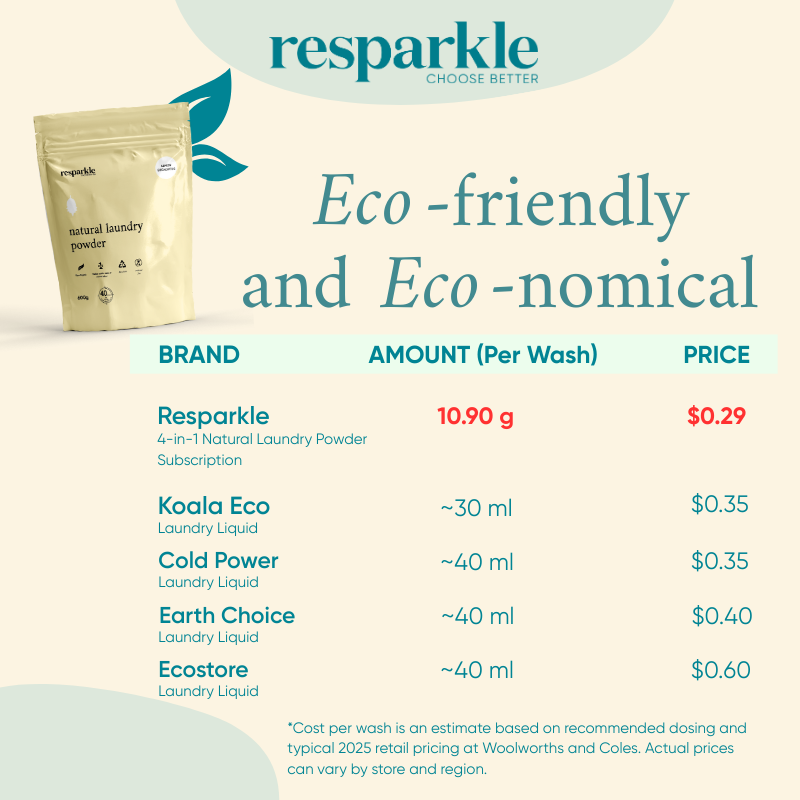
- Cost-per-wash: $0.33 at the 2-3 tsp dose ($18 / 600 g / 55 washes).
- Awards: 2020 Australian Non-Toxic Awards Gold + Editor's Choice.
Where Resparkle doesn't win
Three honest gaps.
- No B Corp or ACO certification. Two of the heaviest third-party logos in the category are not currently on our pack. If B Corp is your single non-negotiable filter, we don't pass it yet.
- Direct-to-consumer only. Not in Coles or Woolworths. If you can't or won't buy online, Ecostore at the supermarket is the next-best plant-based pick on a shelf.
- Narrower range. Resparkle is laundry-led with adjacent products. If you want one brand for laundry plus dish, hand, glass, floor, bath, and kitchen, brands like Koala Eco have a broader home-cleaning lineup. We don't try to compete there.
These are real trade-offs. They tell you when a different powder is the better fit for your specific household, which is the point of the framework.
If you want a ranked pick rather than a framework, see Best natural laundry detergent Australia 2026 or Best natural laundry powder Australia 2026. Both rank current AU options against the framework you just read.
For deeper reading on the proof side: EWG ratings explained for laundry detergent and Is your laundry detergent greenwashing?.
What to do next

If you want to skip the audit and try a powder that passes the framework as written, the Resparkle Natural Laundry Powder is a powder designed around these same values: safety, transparency, performance, and lower waste. 600 g, 55 washes, $18, compostable bag, every ingredient EWG 1 or 2, independently lab-tested against the CHOICE #1 supermarket benchmark. The fastest read on whether it works in your household is the Complete Laundry Bundle at $89: four 600 g powders plus a 700 g universal stain remover, enough for 220+ washes.
Run the six-step checklist on whatever's already under your sink. If it falls short, it may be worth exploring a powder that better matches your priorities.
By the Resparkle team, a small family business based in Brisbane. Last updated: 2026-05-06.
Sources
- Environmental Working Group, Guide to Healthy Cleaning, Laundry Detergent ratings: https://www.ewg.org/cleaners/categories/9-laundry/
- ACCC, greenwashing internet sweep and enforcement priorities: https://www.accc.gov.au/about-us/publications/serial-publications/internet-sweeps/greenwashing-internet-sweep
- ACCC v Clorox Australia (ocean plastic civil penalty case): https://www.minterellison.com/articles/accc-launches-court-action-over-ocean-plastic-claims
- Australian Certified Organic Standard (ACOS): https://austorganic.com/certification-and-standards/standards/acos/
- B Corp certification, B Lab Australia and Aotearoa New Zealand: https://bcorporation.com.au/
- Climate Active (Australian Government carbon-neutral standard): https://www.climateactive.org.au/
- Australian Made trademark and licensing: https://www.australianmade.com.au/
- Standards Australia AS 4736 (industrial compostable plastics) and AS 5810 (home compostable plastics): https://www.standards.org.au/
- CHOICE laundry detergent lab tests: https://www.choice.com.au/home-and-living/laundry-and-cleaning/laundry-detergents/articles/the-best-and-worst-laundry-detergents
- Choose Cruelty Free / Cruelty Free International (Leaping Bunny): https://www.crueltyfreeinternational.org/